
Reviewed by medical experts • For informational purposes only
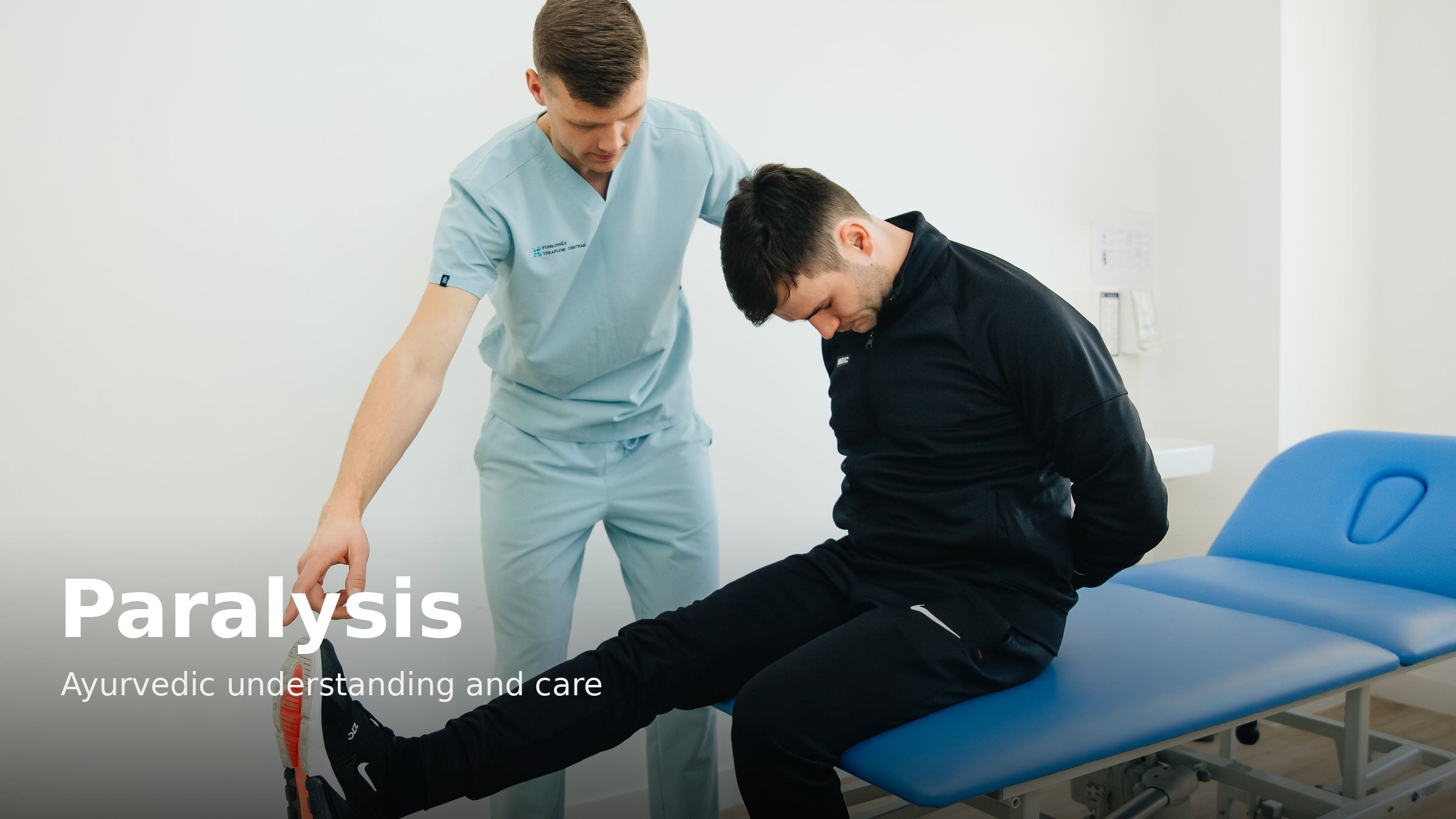
Sudden paralysis is always an emergency - stroke treatment works only within hours. Recovery through rehabilitation, and the classical Pakshaghata view.
Paralysis is loss of muscle movement in part of the body - one side (hemiplegia, usually after stroke), the face (Bell's palsy), both legs (paraplegia, usually spinal cord), or all four limbs (quadriplegia). The single most important fact: sudden paralysis is a medical emergency. Stroke treatment that can reverse paralysis works only within hours - minutes decide outcomes.
Classical Ayurveda describes these patterns in the Vata-vyadhi (neurological disorders) chapters: Pakshaghata (hemiplegia), Ardita (facial palsy), Ekanga-roga (one limb) and Sarvanga-roga (the whole body) - a remarkably close descriptive mapping, built around Vata as the governor of movement. These are traditional interpretive frameworks, not exact translations of a modern diagnosis.
These terms explain a traditional model of motor loss. Modern neurology localizes the lesion - brain, spinal cord, nerve or muscle - because location decides both cause and treatment.
In the traditional account, paralysis follows severe Vata provocation - suppression of urges, trauma, improper posture and diet, and debility - drying and obstructing the channels of movement. These are traditional explanations.
In modern medicine: stroke (the commonest cause of one-sided paralysis - blocked or burst brain artery), spinal cord injury, Bell's palsy (facial nerve inflammation), nerve compression or injury, Guillain-Barre syndrome, brain tumours, infections, and muscle diseases. Stroke risk factors are the big modifiables: blood pressure, diabetes, smoking, cholesterol, atrial fibrillation.
In the traditional account, severely aggravated Vata invades the channels carrying movement and sensation to the affected region, which then loses function; the longer the obstruction, the harder the recovery. This is a traditional explanatory model, not a proven account of neural injury.
In modern understanding, the neural pathway to the muscle is interrupted - brain cells dying within minutes in stroke (hence thrombolysis and thrombectomy time windows), cord tracts damaged in injury, or peripheral nerve conduction failing in Bell's palsy and neuropathies. Recovery then depends on surviving neurons relearning through rehabilitation - neuroplasticity is real, effort-driven and front-loaded in the first months.
| Component | Traditional interpretation, not a laboratory diagnosis |
|---|---|
| Dosha | Vata severely aggravated; Kapha may obstruct |
| Dushya | Snayu, Sira and Mamsa, traditional concepts |
| Srotas | Channels of movement and sensation, traditional concept |
| Srotodushti | Obstruction of motor channels, a traditional concept |
| Agni | Often weakened, a traditional concept |
| Ama | Sometimes implicated traditionally |
| Adhisthana | The affected limb, half-body, face, or whole body |
These are not validated categories for assessing paralysis; neurological examination and imaging do that.
Sudden inability to move the face, arm or leg on one side; drooping face, slurred speech; or gradual weakness depending on cause. Numbness often accompanies the weakness.
Call emergency services immediately for: sudden face-arm-speech disturbance (the FAST check - Face drooping, Arm weakness, Speech difficulty, Time to call), sudden loss of leg movement, weakness with severe headache, or weakness after neck or back injury. Time-critical stroke treatment can reverse paralysis only in the first hours - do not wait to "see if it passes," even if it seems to improve (transient attacks warn of coming stroke). Gradual weakness, facial drooping without stroke features, and tingling patterns also deserve prompt - not emergency - medical review.
Modern classification is by pattern and cause: hemiplegia (stroke, brain lesions), paraplegia and quadriplegia (spinal cord), monoplegia (one limb, nerve or focal brain), facial palsy (Bell's or stroke - the forehead test distinguishes them), and flaccid versus spastic by tone. Each has its own prognosis and treatment path.
The classical mapping - Pakshaghata, Ardita, Ekanga-roga, Sarvanga-roga - mirrors these patterns closely, which is why paralysis is the classical system's most serious Vata territory. Traditional pattern labels cannot localize the lesion; MRI and neurological examination do that.
Diagnosis is urgent neurological assessment plus imaging: CT or MRI brain for stroke, MRI spine for cord problems, nerve studies for peripheral causes. In stroke, the scan also decides clot-busting treatment eligibility - every minute saved is brain saved.
In the traditional framework, a practitioner assesses Vata pattern, strength and chronicity. This has no role in the acute phase; its place, if any, is adjunctive rehabilitation after medical stabilization.
Nutrition supports recovery: adequate protein for muscle rebuilding, swallowing assessment first after stroke (aspiration risk - food consistency may need modification), and a heart-protective pattern for secondary stroke prevention. Classical texts favour warm, nourishing, easily digested food in Vata disorders - compatible advice once swallowing is safe.
Rehabilitation is the treatment: physiotherapy, occupational therapy and speech therapy started early and sustained - movement relearned through daily practice. Prevent the complications: regular repositioning against bed sores, passive movement against contractures, DVT prevention, and mood support (post-stroke depression is common and treatable). Home safety - rails, non-slip surfaces, wheelchair access - restores independence. For prevention, control blood pressure, diabetes and smoking relentlessly. Classical Abhyanga (oil massage) is a reasonable comfort adjunct in stable recovery.
Acute stroke treatment is emergency medicine: thrombolysis or thrombectomy within hours, then blood thinners, statins and pressure control for prevention - none of this has a traditional substitute, and delaying it for any other treatment costs brain. Bell's palsy is treated early with steroids, which improve recovery. Classical Vata-hara care - Basti (medicated enema therapy), Nasya, herbal oils and formulations - is the traditional system's flagship for these conditions and may be pursued as adjunctive rehabilitation with a qualified practitioner after medical stabilization, never instead of emergency or preventive treatment. Discuss all formulations with both your neurologist and a qualified Ayurvedic practitioner.
Basti is the classical headline therapy for Vata-vyadhi including Pakshaghata, with Abhyanga and Nasya alongside - traditional adjuncts in the rehabilitation phase under qualified supervision. They are contraindicated as a substitute for acute stroke care; timing and medical clearance matter.
Recovery depends on cause and speed of treatment. Stroke: the fastest recovery happens in the first three to six months of rehabilitation, continuing more slowly for years - early thrombolysis changes everything. Bell's palsy: most recover substantially within weeks to months, faster with early steroids. Spinal cord injury: recovery is partial and rehabilitation defines function. At every stage, consistent rehabilitation outperforms any single intervention. Classical texts too call chronic Pakshaghata difficult and early treatment far more promising.
The descriptive overlap is striking - both traditions map the same patterns and both emphasize early treatment. The critical differences are modern: stroke thrombolysis has no traditional equivalent and is brutally time-limited, and structured rehabilitation is the proven engine of recovery. Traditional terms should be presented as a separate framework, with its limits stated. Sudden paralysis is an emergency first; traditional supportive care can only be an adjunct in stable recovery.
The Ayurveda notebook draws on discussions of Pakshaghata, Ardita and Vata-vyadhi in Charaka Samhita (Chikitsa Sthana 28) and Sushruta Samhita (Nidana Sthana 1). These are background for traditional concepts, not clinical proof of paralysis-reversing effect. Exact verse citations and formulation indications should be checked by a qualified Ayurvedic editor before being quoted as direct text.
The institutional links are general resources, not endorsements of the treatment claims in this article.
Yes - always. Stroke treatment that can reverse paralysis (clot-busting drugs, clot removal) works only within hours of symptom onset. Use FAST (Face, Arm, Speech, Time) and call emergency services immediately, even if symptoms seem to improve.
It depends on cause and timing. Early-treated stroke and Bell's palsy often recover substantially; spinal cord injury is managed toward maximum function. In every case, consistent rehabilitation - physiotherapy, occupational and speech therapy - is what drives recovery.
No. Emergency stroke treatment and secondary prevention (blood pressure, thinners, statins) have no traditional substitute, and delaying them costs brain. Classical Vata therapies may support rehabilitation after medical stabilization, under qualified guidance.
Daily prescribed exercises, fall-proofing the home, skin care and repositioning for immobile limbs, nutrition adapted to swallowing, and watching for depression - very common and treatable after stroke.
Bell's palsy paralyzes the whole half of the face including the forehead; stroke usually spares forehead movement and comes with arm, leg or speech involvement. Both warrant same-day assessment - Bell's palsy improves faster when steroids start early.
Browse our Disease A to Z for more conditions, including our article on Lower Back Pain.
Medical disclaimer: This article is for education, not an individual diagnosis or prescription. Sudden paralysis or face-arm-speech disturbance is an emergency - call emergency services immediately. Rehabilitation and all medications should be directed by the treating medical team.
Written By
Dr. Daksh
BDS
Reviewed By
Dr. Varun Gupta
MD Pharmacology, MBBS
Last updated on
Oct 22, 2026 • 06:23 PM (IST)
Read Our Editorial Policy
Want to know more?
Have issue with the content?
Report Problem
