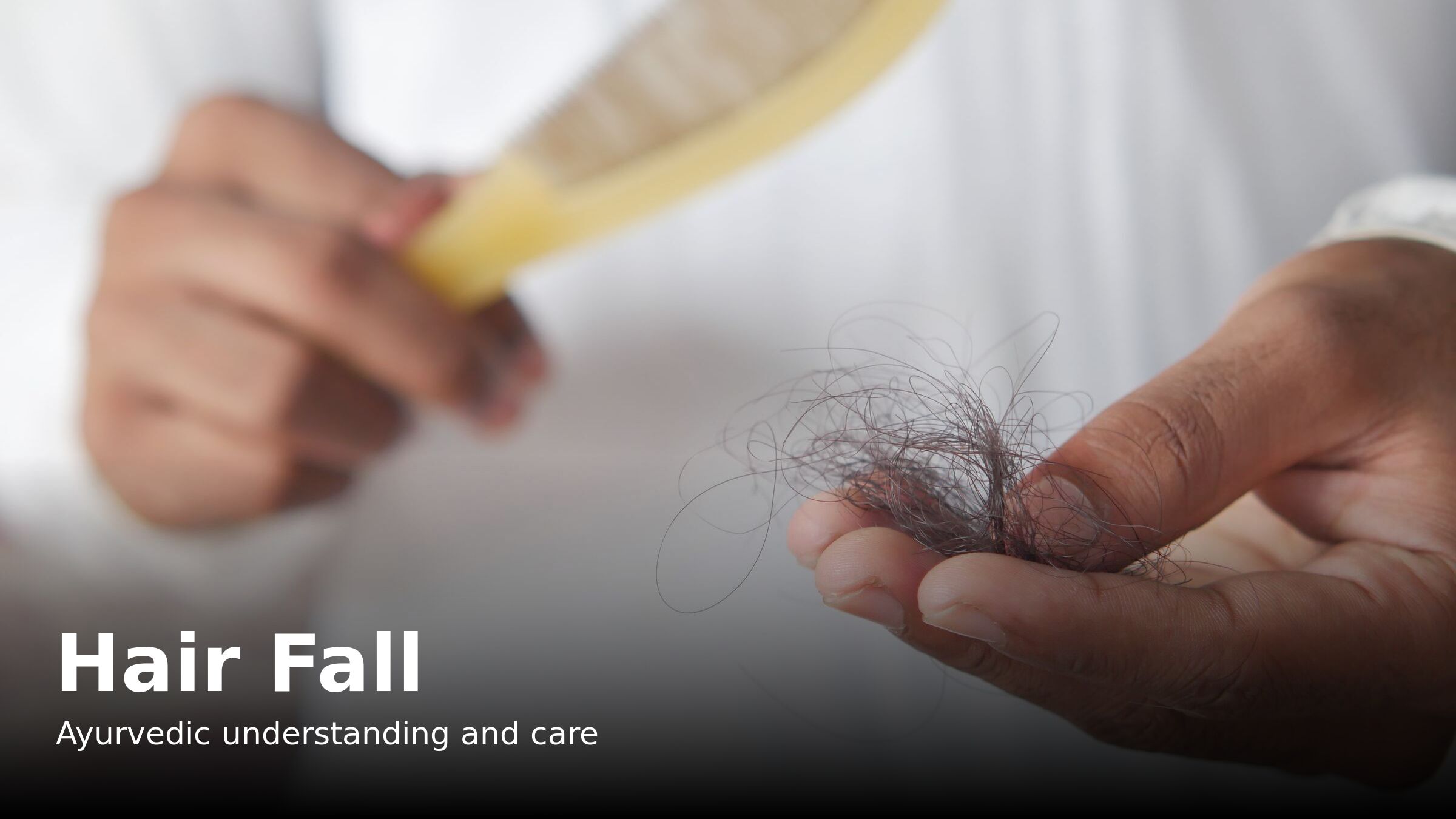
In Ayurveda, continuous excessive hair fall is called Khalitya - the progressive loosening and falling of hair from its roots, which can slowly lead to thinning and baldness. Hair is deeply connected to the health of the body's deeper tissues: it is described as an Upadhatu (by-product) of Rasa Dhatu and a Mala (waste product) of Asthi Dhatu (bone tissue). This is why weak nutrition, poor digestion and weak bones often show up first in the hair.
Ayurveda treats hair fall not as a cosmetic problem but as a sign of internal imbalance - mainly of Pitta and Vata dosha - that heats, dries and blocks the hair roots (Romakupa).
The word "Khalitya" comes from "Khala" (a threshing floor - a bare, empty patch of ground). Just as a threshing floor is swept bare, the scalp becomes bare of hair. Related classical terms:
- Indralupta: sudden hair loss in round patches (comparable to alopecia areata).
- Ruhya or Smashru-gada: loss of beard and moustache hair.
- Palita: premature greying, which often accompanies or precedes hair fall.
Hair fall is classed among the Kshudra Rogas (minor diseases) and Shirorogas (diseases of the head and scalp) in classical texts.
Classical texts like the Charaka Samhita, Sushruta Samhita and Ashtanga Hridaya describe clear causes:
Aharaja Nidana (Dietary causes):
- Ati-Lavana (excess salt): Charaka Samhita (Vimana Sthana 1/18) says that even people accustomed to heavy salt intake fall victim to untimely baldness, greying and wrinkles. Salt-rich packaged snacks, pickles and papads are modern equivalents.
- Ati-Kshara (excess alkali) and too much pungent, sour and bitter food - these heat the blood and dry the hair roots.
- Viruddha Ahara (incompatible food combinations), such as milk with sour or salty food, which create Ama (toxins) and disturb Rasa Dhatu.
Viharaja Nidana (Lifestyle causes):
- Washing the head with hot water: Ashtanga Hridaya (Sutra Sthana 2/7) warns that hot water on the head weakens the hair and eyes.
- Excessive exposure to the sun and heat, staying awake late at night, and over-exertion.
- Chemical hair dyes, harsh shampoos and unhygienic water (classically described under Dushi-visha - slow toxic exposure).
Manasika Nidana (Mental causes):
- Intense anger, grief, stress and worry. Mental heat rises to the head (Uttamanga) and scorches the hair roots - which is why hair fall often spikes during stressful periods.
Ayurveda explains hair fall through Samprapti - the step-by-step process of disease:
- Due to the causes above, Pitta (especially Bhrajaka Pitta in the scalp) and Vata get aggravated.
- These aggravated doshas travel upward and lodge in the scalp - the soil of the hair (Kesha-bhoomi).
- The sharp, hot nature of Pitta, with drying Vata, "cooks" and loosens the hair roots, so existing hair starts falling.
- Vitiated Kapha with vitiated Rakta (blood tissue) then fills and blocks the hair pores (Romakupa).
- Because the pores are blocked, new hair cannot sprout - the result is lasting hair fall, thinning (Khalitya) or patchy loss (Indralupta).
Samprapti Ghataka (the components of the disease process):
Component
Involvement in Hair Fall
Dosha
Pitta-predominant Tridosha (Bhrajaka Pitta in the scalp, Prana-Vyana Vata, Kledaka Kapha blocking pores)
Dushya (tissues affected)
Rasa Dhatu, Rakta Dhatu, Asthi Dhatu, skin and hair pores (Romakupa)
Srotas (channels)
Rasavaha, Raktavaha and Swedavaha Srotas
Srotodushti type
Sanga (blockage of hair pores) and Kshaya (wasting of hair-root tissue)
Agni
Weak Dhatu Agni - especially of Rasa and Asthi Dhatu
Ama
Usually Nirama (little Ama); sometimes Sama Rasa
Adhisthana (site)
Scalp (Shiras / Kesha-bhoomi)
Roga Marga
Bahya (external pathway)
- Early Symptoms:
- More hair than usual on the pillow, comb or bathroom floor.
- Hair becoming thin, dry, rough and losing its shine.
- Mild itching, burning or heat sensation in the scalp; dandruff (Darunaka).
- Advanced Symptoms:
- Continuous heavy hair fall during washing and combing.
- Visible thinning, receding hairline or widening parting.
- Smooth round bald patches (Indralupta) or loss of beard hair (Ruhya).
- Premature greying along with hair fall.
- Vataja Khalitya:
- Dry, rough, cracked scalp; brittle hair; mild tingling or pricking sensation.
- Pittaja Khalitya:
- Red, hot, burning scalp; rapid greying along with hair fall.
- Kaphaja Khalitya:
- Oily, heavy scalp with thick dandruff, itching and sticky secretions blocking the pores.
- Sannipataja (Tridoshaja):
- Features of all three doshas; shiny, smooth scalp with destroyed hair roots - considered difficult to cure.
- Raktaja / Indralupta:
- Caused by vitiated blood tissue; sudden well-defined bald patches on scalp or beard, sometimes with local burning.
- Ayurvedic Diagnosis (Roga-Rogi Pariksha):
- History: diet (salt, spice), hot-water head baths, stress, sleep, chemical treatments, family history.
- Examination: type of scalp (dry/oily/red), pattern of hair loss (diffuse or patchy), dandruff, hair shaft strength.
- Nadi Pariksha: dominant dosha imbalance (usually Pitta-Vata).
- Modern Diagnosis:
- Clinical examination, hair pull test, dermoscopy; blood tests for thyroid, iron (ferritin), vitamin D, vitamin B12 when needed.
- Differential Diagnosis (brief):
- Alopecia areata (Indralupta), telogen effluvium after illness or delivery, thyroid-related hair loss, androgenetic (pattern) baldness and fungal infection (Dadru) should be distinguished.
Ayurvedic treatment of hair fall works on three levels: cool and calm the aggravated Pitta, remove the blockage of the hair pores, and nourish the deeper tissues (especially Rasa and Asthi Dhatu) so strong hair can grow back.
- Pathya (Beneficial):
- Cow's milk, cow's ghee and fresh butter - they cool Pitta and nourish the tissues that build hair.
- Black sesame seeds (Tila) and sesame oil - classical Keshya (hair-nourishing) foods.
- Amla (Indian gooseberry), soaked raisins, pomegranate and seasonal fruits.
- Old wheat, red rice, green gram (moong) and barley.
- Apathya (Avoid):
- Excess salt - the most clearly condemned cause of early baldness in classical texts; cut down pickles, papads, packaged and instant foods.
- Excess pungent and sour food - too much chilli, mustard oil, vinegar and sour curd.
- Incompatible combinations like milk with fish or sour fruits.
- Never wash your head with hot water - Ashtanga Hridaya (Sutra 2/7) clearly says hot water on the head weakens hair and eyes. Use room-temperature or lukewarm water.
- Oil your scalp regularly: gentle massage (Siro Abhyanga) 2-3 times a week with a cooling medicated oil, left for at least 30 minutes before washing.
- Comb gently with a clean wide-toothed comb; never comb wet hair roughly.
- Protect the head from harsh sun, hot wind, smoke and dust with a light scarf or cap.
- Sleep on time - late nights directly increase dryness and heat in the scalp.
- Manage anger, grief and worry - these push heat to the head; Pranayama such as Anulom-Vilom and Shitali helps.
- Avoid chemical hair dyes and harsh shampoos; use mild, natural cleansers.
Classical herbs and formulations used for Khalitya and Indralupta, chosen by the physician:
- Bhringaraja (Eclipta alba): called Kesharaja - the "king of hair herbs"; pacifies Pitta and stimulates dormant follicles. Used as oil, juice or powder.
- Amalaki (Amla): premier Rasayana; nourishes Rasa and Asthi Dhatu, cools the scalp; used internally and as oil.
- Shadbindu Taila: classical oil (Bhringaraja juice, sesame oil, goat's milk, Eranda, Jivanti, Rasna) used as Nasya - said to strengthen hair roots and teeth and improve eyes.
- Anu Taila: daily Nasya oil for head health.
- Bhringamalakadi Taila / Triphaladi Taila: medicated oils for scalp massage.
- Narasimha Rasayana / Amalaki Rasayana: internal rejuvenating confections taken for 1-3 months in chronic thinning.
These medicines should be taken only in the dose advised by a qualified Ayurvedic physician. You can consult verified Ayurvedic doctors on the Sanatan Ayurveda app (consult a doctor) for a personalised prescription.
- Siro Abhyanga: regular medicated scalp massage - cures dryness, itching and hair drop.
- Siro Picu: a cotton pad soaked in Bhringaraja or Nimbadi Taila kept on the scalp or bald patches - specifically indicated in hair fall and scalp cracks.
- Sirovasti: retaining warm medicated oil over the head in a special cap - used in obstinate scalp and Vata disorders, done in a clinic.
- Nasya: 2-6 drops of Anu Taila or Shadbindu Taila in each nostril - "the nose is the door of the head"; clears head channels and nourishes hair roots from within.
- Pracchana (superficial scarification) with Keshya Lepa: for patchy loss (Indralupta), classical texts advise gentle pricking of the bald patch followed by pastes like Bhringaraja juice to wake up blocked follicles. Done only by a trained physician.
- Sukha-Sadhya (easily curable): recent hair fall in a young, healthy person, where the follicles are still alive - responds well to diet correction, oiling, Nasya and Keshya herbs within a few months.
- Krichrasadhya (difficult): hair fall lasting years, with heavy dandruff or two-dosha involvement - needs sustained treatment and Panchakarma.
- Asadhya (not curable): long-standing total baldness where the scalp has become completely smooth and shiny like a nail - the roots are destroyed; treatment then focuses on stopping further loss and overall health.
- Modern medicine agrees that early treatment works best; once follicles miniaturize fully, regrowth is limited - so starting care early matters.
- Similarities:
- Khalitya broadly matches chronic telogen effluvium and early androgenetic thinning; Indralupta matches alopecia areata. Modern medicine also links hair loss to nutrition (iron, vitamin D), stress, thyroid imbalance and harsh hair practices - see the NHS hair loss guidance and the American Academy of Dermatology's overview of hair loss causes.
- Differences:
- Modern treatment uses minoxidil, finasteride and supplements; Ayurveda works through dosha correction, scalp procedures (Murdha Taila, Nasya), diet and Rasayana nourishment.
- Limitations of correlation:
- Ayurvedic types are defined by dosha signs, not by blood tests or biopsies, so the match is a close correlation, not a one-to-one identity. Sudden patchy loss, scalp infection signs or rapid baldness should be medically evaluated.
- Classical texts:
- Charaka Samhita, Sutra Sthana 26/43 and Vimana Sthana 1/17-18 (salt, alkali and baldness; Khalitya among Rasa and Asthi disorders).
- Sushruta Samhita, Nidana Sthana 13 (Kshudraroga Nidana - Khalitya, Indralupta, Ruhya).
- Ashtanga Hridaya, Sutra Sthana 2/7 (hot-water head bath warning), 6/22 (Kasmarya), 22/34 (Murdha Taila benefits); Uttara Tantra 23.
- Madhava Nidana, Chapter 55 (Kshudraroga Nidana).
- Sharangadhara Samhita / Bhaishajya Ratnavali - Shadbindu Taila, Bhringamalakadi Taila, Narasimha Rasayana.
- The Ayurvedic Pharmacopoeia of India - Bhringaraja, Amalaki, Tila, Anu Taila.
- Modern research:
- NHS (UK) - Hair loss
- American Academy of Dermatology - Hair loss: causes
- Government / institutional sources:
- Ministry of AYUSH, Government of India
- Central Council for Research in Ayurvedic Sciences (CCRAS)
Q: How much daily hair fall is normal?
A: Losing up to about 50-100 hairs a day is considered normal - hair has a natural growth and shedding cycle. It becomes a concern when you see clumps on the pillow or comb, visible thinning, a widening parting or bald patches. That is when the classical causes - excess salt, heat, stress, poor sleep - are usually at work and worth correcting.
Q: Does applying oil really help hair fall?
A: Yes - regular scalp oiling (Siro Abhyanga) is one of Ayurveda's most praised daily habits. Ashtanga Hridaya says keeping oil on the head prevents hair fall, greying and scalp cracking, and strengthens the head. Use a cooling oil like Bhringaraja or coconut-based medicated oil, massage gently, leave 30 minutes or overnight, and wash with lukewarm - never hot - water.
Q: I wash my hair with hot water in winter. Is that bad?
A: Classical texts warn specifically about hot water on the head: it weakens the hair roots and eyes, even though a warm body bath is fine. Use lukewarm or cool water for the head, especially if you already have hair fall, burning scalp or early greying.
Q: Can stress alone cause hair fall?
A: Yes. Ayurveda lists anger, grief and worry (Krodha, Shoka, Chinta) as direct causes - mental heat rises to the head and scorches the hair roots. Modern medicine agrees: high stress can push many hairs into the shedding phase (telogen effluvium) a few months after a stressful event. Managing stress is a real part of treatment, not an optional extra.
Q: Which single food is best for hair?
A: Amla (Indian gooseberry) - it is both a premier Rasayana and a cooling Pitta-pacifier that nourishes the tissues from which hair is made. Black sesame seeds come a close second as a daily Keshya food. Together with reduced salt, these simple diet changes support every other treatment.
Q: My hair is falling in one round patch. What is that?
A: That pattern matches Indralupta - comparable to alopecia areata. Ayurveda treats it by clearing the blocked follicle (Pracchana scarification by a physician, followed by Bhringaraja-based pastes) along with internal medicines. Because patchy loss can also have autoimmune or fungal causes, get it examined rather than self-treating.
Medical disclaimer
This content is for education and does not replace a consultation. Ayurvedic treatment should be taken under the guidance of a qualified practitioner. In an emergency, contact local emergency services.
Related reading on Sanatan Ayurveda: Disease A-Z library · Constipation · Acne · Consult a doctor