
Reviewed by medical experts • For informational purposes only
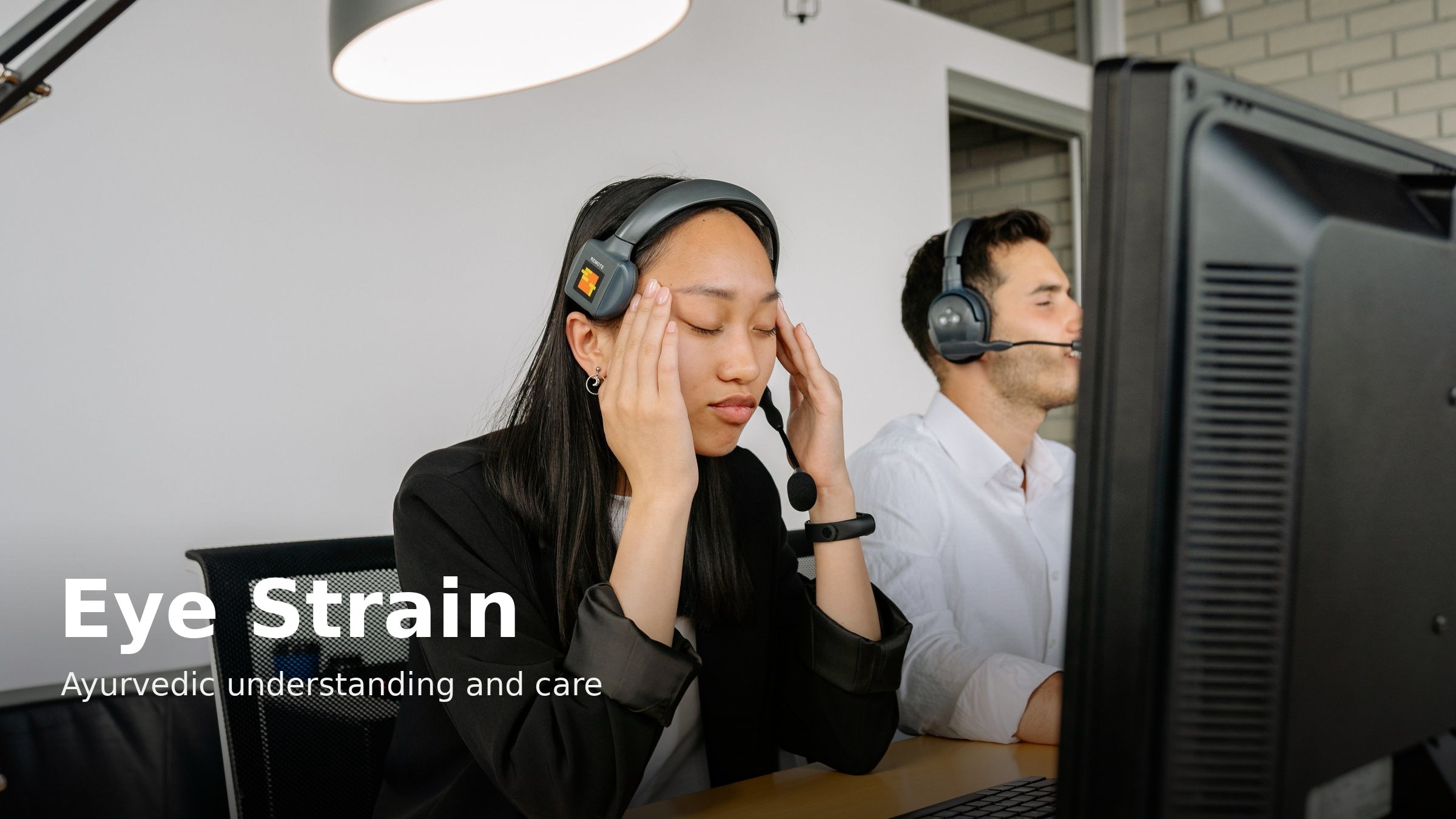
Screen-tired eyes are reversible and harmless, but persistent symptoms deserve an eye test. The 20-20-20 rule, the classical Netra view, and the red flags.
Eye strain (asthenopia) is tired, aching, dry or heavy eyes - often with headache and blurred focus - after prolonged close work, especially screens. It is uncomfortable but not damaging: eye strain does not cause permanent harm to the eyes. It usually settles with rest, better screen habits, and treating any underlying cause like an uncorrected prescription or dry eye.
Classical Ayurveda treasures the eyes - "protect your eyes above all organs" - and describes eye disorders under Netra-roga, with vision governed by Alochaka Pitta. Prolonged gazing, sleeplessness and strain aggravate Vata-Pitta in the eyes, producing tiredness, burning and dryness. Classical daily routine includes dedicated eye care. These are traditional interpretive frameworks, not exact translations of a modern diagnosis.
These terms explain a traditional model of eye fatigue. Modern eye care explains screen strain through reduced blinking, sustained focusing effort, and dry eye - mechanical, reversible causes.
In the traditional account, the eyes are strained by prolonged staring, excessive heat and bright light, sleeplessness, reading while lying down or in moving vehicles, and suppressing natural urges - much of which matches the modern list remarkably well.
In modern eye care, the drivers are: staring at screens (blink rate drops by half or more, so the tear film dries), sustained near focus (ciliary muscle fatigue), poor lighting or glare, incorrect screen distance and height, uncorrected or wrong glasses prescription, dry eye, and inadequate sleep. Underlying eye conditions - convergence problems, binocular vision issues - make some people strain-prone.
In the traditional account, overuse and heat aggravate Vata and Pitta; Alochaka Pitta is disturbed, the eyes dry and tire, and vision fatigues by evening. This is a traditional explanatory model, not a proven account of visual physiology.
In modern understanding, long near focus keeps the focusing muscle contracted (fatigue and blur), while reduced blinking lets the tear film break up (dryness, burning, gritty feeling and reflex watering). Add glare, poor contrast and a wrong prescription, and the visual system works overtime - the result is aching eyes, frontal headache and end-of-day blur. All of it reverses with rest and correction.
| Component | Traditional interpretation, not a laboratory diagnosis |
|---|---|
| Dosha | Vata and Pitta predominant |
| Dushya | Netra (the eyes), traditional concept |
| Srotas | Channels of the head and eyes, traditional concept |
| Srotodushti | Kshaya (depletion/dryness), a traditional concept |
| Agni | Not central in the traditional account |
| Ama | Not central in the traditional account |
| Adhisthana | Netra (eyes); Alochaka Pitta seat |
These are not validated categories for diagnosing eye problems; an eye examination does that.
Tired, sore, burning or itchy eyes; dryness or paradoxical watering; blurred or double vision after long work; difficulty focusing when looking up from a screen; frontal headache; sensitivity to light; and neck and shoulder ache from poor posture. Symptoms build through the day and ease with rest.
See an eye specialist promptly for: sudden vision loss or a curtain over vision, a flood of floaters or flashes of light, severe eye pain with nausea or haloes around lights, double vision that persists at rest, or a red painful eye - these are not eye strain. Persistent strain symptoms despite good habits warrant an eye test, since an uncorrected prescription or dry-eye condition is often the hidden driver.
Modern practice separates simple visual fatigue (habits and ergonomics) from strain driven by uncorrected refractive error, dry eye disease, or binocular-vision problems - because the fix differs: habits and lubricants, glasses, dry-eye treatment, or vision therapy.
The classical tradition distinguishes Vata-type (dryness, ache, fatigue) from Pitta-type (burning, redness, light sensitivity) eye complaints. Traditional pattern labels cannot measure your prescription or tear film; an eye examination does that.
Eye strain itself is diagnosed from the story: symptoms that track screen and near work and ease with rest. An optometrist's examination checks visual acuity, prescription, eye teaming, and the tear film and ocular surface - worth doing if symptoms persist or you have not had a test in two years. Children with strain symptoms should be examined, as uncorrected focusing problems are common.
In the traditional framework, a practitioner assesses dosha pattern, sleep, work habits and digestion. This cannot measure your prescription or tear film; an eye test comes first when symptoms persist.
General eye nutrition: a diet with green leafy vegetables, coloured vegetables and fruits, and omega-3 sources supports eye health; adequate water helps the tear film. Classical texts prize Triphala, ghee, and Amla for the eyes - traditional supports, not proven strain treatments.
The proven fixes are behavioural: the 20-20-20 rule (every 20 minutes, look at something 20 feet away for 20 seconds); conscious full blinking; screen slightly below eye level and an arm's length away; match screen brightness to the room and cut glare; enlarge text; and take real breaks. Sleep restores the tear film. Lubricating eye drops (artificial tears) are safe and effective for dryness. Classical Dinacharya includes eye exercises and cool-water splashing - harmless, pleasant additions.
No medicine is needed for ordinary eye strain. Artificial tears handle dryness; a correct glasses prescription handles refractive causes. Classical eye care includes Netra Tarpana (ghee eye-bathing) and Triphala-based preparations - traditional therapies with limited modern evidence. Important safety rule: never put anything non-sterile into the eyes, never use homemade eye drops, and discard contaminated drops. Discuss any traditional eye preparation with an eye specialist and a qualified Ayurvedic practitioner first - eyes are unforgiving.
Netra Tarpana is the classical specialist procedure for tired, dry eyes, performed by trained practitioners under hygienic conditions; some find it soothing, evidence is limited. Nasya and Shirodhara are used traditionally for head and eye complaints. None replaces an eye examination, and none should be done with unsterile materials.
Eye strain is benign and fully reversible: it settles within hours to days of rest and recurs only with the same habits. Fix the habits and the prescription, and it stops recurring. It does not damage the eyes or worsen vision permanently - but treat persistent symptoms as a prompt for an eye test, since they often flag a correctable cause.
Both traditions converge: rest the eyes, vary the gaze, sleep well, keep them moist. The classical emphasis on eye care within daily routine is admirable. Where modern care adds value is measurement - the prescription, the tear film, binocular vision - and safe, sterile lubricants. Traditional terms should be presented as a separate framework, with its limits stated. Persistent symptoms deserve an eye test; traditional supportive care can only be an adjunct.
The Ayurveda notebook draws on discussions of Netra-roga, Alochaka Pitta and Netra Tarpana in Sushruta Samhita (Uttara Tantra 1-18), Ashtanga Hridaya (Uttara Tantra 11-16) and Charaka Samhita (Sutra Sthana 5 on Dinacharya). These are background for traditional concepts, not clinical proof of effect. Exact verse citations and formulation indications should be checked by a qualified Ayurvedic editor before being quoted as direct text.
The institutional links are general resources, not endorsements of the treatment claims in this article.
No. Screens cause strain and dryness, not damage. Discomfort is real but reversible; it does not worsen your vision or eyesight permanently.
The 20-20-20 rule, conscious blinking, artificial tears for dryness, and good sleep. If symptoms persist, get your prescription and tear film checked.
In trained, hygienic hands it is a soothing traditional therapy, but the eye is unforgiving of unsterile practice. Never attempt ghee or herbal preparations in the eyes at home, and see an eye specialist for persistent symptoms.
Only if you have an uncorrected prescription - a correct ordinary prescription is what matters. Blue-light-filtering glasses have no proven benefit for eye strain; the strain comes from focus effort and dry eyes, not blue light.
If symptoms persist despite better habits, if you have not had an eye test in two years, or immediately for sudden vision changes, severe pain, haloes, or double vision.
Browse our Disease A to Z for more conditions.
Medical disclaimer: This article is for education, not an individual diagnosis or prescription. Sudden vision changes, severe eye pain, or double vision need prompt medical assessment. Never put non-sterile preparations in the eyes; discuss all products with a qualified clinician.
Written By
Dr. Daksh
BDS
Reviewed By
Dr. Varun Gupta
MD Pharmacology, MBBS
Last updated on
Oct 22, 2026 • 06:23 PM (IST)
Read Our Editorial Policy
Want to know more?
Have issue with the content?
Report Problem
