
Reviewed by medical experts • For informational purposes only
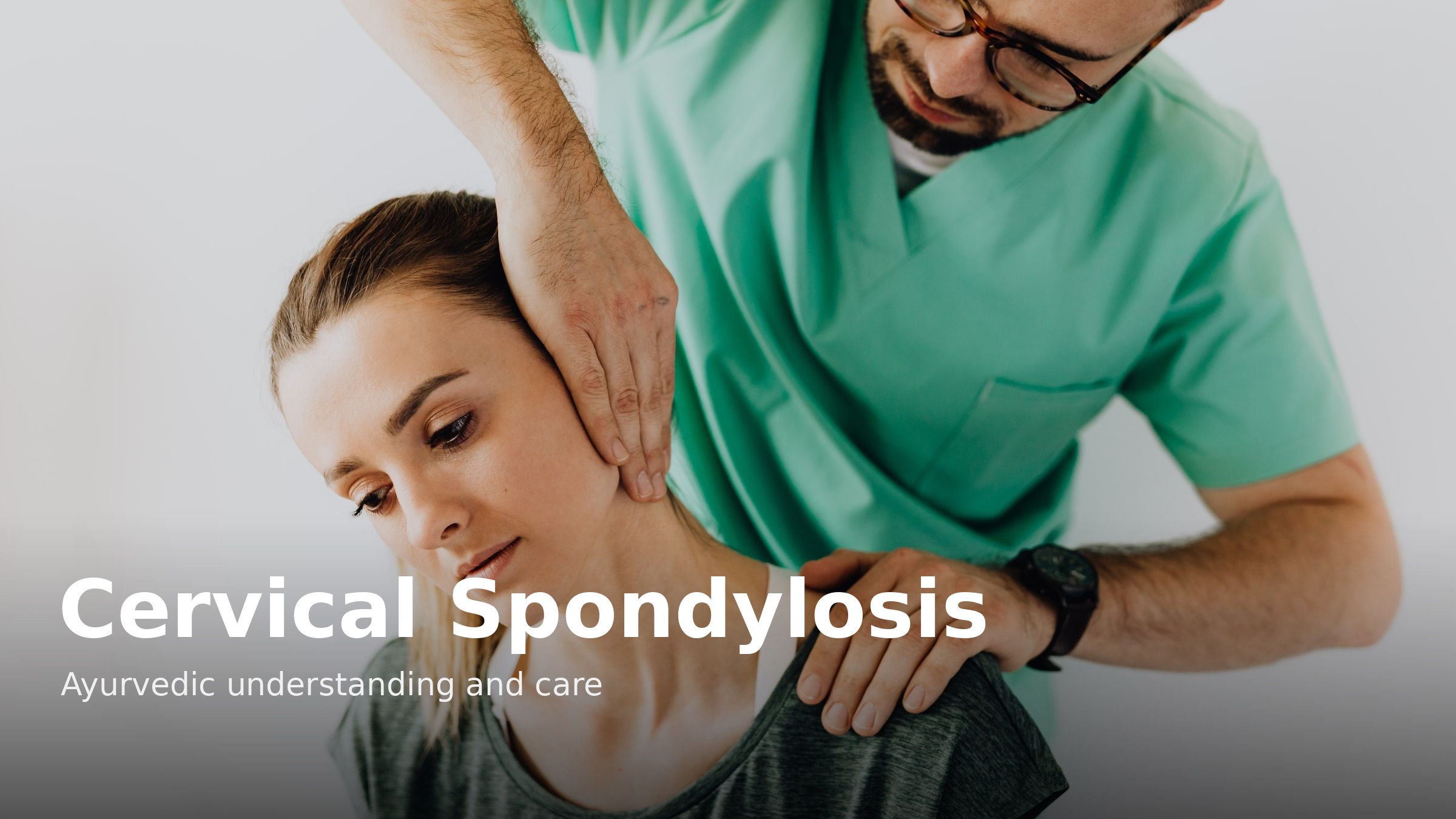
Neck wear is common after 40 and usually settles with movement, posture and time. What helps flares, the Greeva/Manya-stambha view, red flags.
Cervical spondylosis is age-related wear of the neck's discs and joints - present on scans in most people over 40, often without symptoms. When symptomatic it brings neck pain, stiffness and sometimes pain or tingling into the arm; most flare-ups settle in weeks with simple measures, and only a small minority need specialist care.
Classical Ayurveda describes neck stiffness and pain as Manya-stambha and Greeva-graha - Vata disorders of the neck - with a full toolkit of oiling, fomentation, Greeva Basti (oil pooling on the neck) and Nasya. These are traditional interpretive frameworks, not exact translations of a modern diagnosis.
These terms explain a traditional model of neck degeneration. Modern medicine understands cervical spondylosis as disc dehydration and joint osteoarthritis, sometimes narrowing spaces for nerves or the cord.
In the traditional account, neck disorders follow Vata aggravation - prolonged forward-bent postures, cold exposure, improper pillows, suppression of urges and debility. These are traditional explanations.
In modern medicine: age is the main driver - discs dehydrate and joints wear over decades. Contributors include years of forward-head posture (screens, desk work), previous neck injury, smoking, heavy physical work and genetics. "Text neck" from phones plausibly adds load, though age remains the dominant factor.
In the traditional account, aggravated Vata settles in the neck's channels, drying lubrication, stiffening movement and causing pain; with time the stiffness becomes structural. This is a traditional explanatory model, not a proven account of disc degeneration.
In modern understanding, discs lose water and height with age; joints form osteophytes (bone spurs). Most of this is asymptomatic. Symptoms arise from muscle strain and facet irritation (the common ache), nerve root compression (arm pain, tingling - cervical radiculopathy), or rarely cord compression (cervical myelopathy - the serious version). Most flares are muscular and settle with movement and time.
| Component | Traditional interpretation, not a laboratory diagnosis |
|---|---|
| Dosha | Vata predominant; Kapha stiffness contributing |
| Dushya | Asthi (bone) and Snayu (ligaments), traditional concepts |
| Srotas | Channels of the neck, traditional concept |
| Srotodushti | Obstruction and drying, a traditional concept |
| Agni | Not central in the traditional account |
| Ama | Sometimes implicated traditionally |
| Adhisthana | Greeva (neck), Manya (nape) |
These are not validated categories for assessing neck degeneration; examination and imaging do that.
Neck pain and stiffness, worse after static postures; reduced turning range; grinding sensation on movement; sometimes headache from the neck; arm pain, tingling or numbness when a nerve is irritated.
Seek prompt care for: arm or hand weakness or clumsiness, trouble walking or balance changes, bladder or bowel changes, numbness around the inner thighs (cord compression signs - urgent), fever or weight loss with neck pain, pain after significant injury, or severe unrelenting night pain. These point beyond ordinary spondylosis.
Modern classification separates axial neck pain (muscular/joint, the common kind), cervical radiculopathy (nerve root - arm symptoms), and cervical myelopathy (cord compression - the urgent kind). Imaging severity correlates poorly with pain - worn-looking necks can be painless and smooth ones sore.
The classical tradition describes neck Vata patterns of stiffness and pain. Traditional pattern labels cannot identify cord compression; neurological examination and MRI do that.
Diagnosis is clinical for ordinary neck pain; X-ray or MRI is reserved for persistent cases, neurological signs or red flags - scans are not routine because age-related changes are nearly universal and mislead. Neurological examination (reflexes, strength, sensation) screens for root and cord involvement.
In the traditional framework, a practitioner assesses Vata pattern, posture and chronicity. This cannot screen for cord compression; neurological examination does that.
No diet treats spondylosis; general bone-friendly nutrition (adequate calcium, vitamin D, protein) is sensible. Classical texts favour warm, unctuous, Vata-pacifying food for joint conditions - compatible advice.
Movement is medicine: daily neck range-of-motion and postural exercises (a physiotherapist's set is ideal), regular breaks from screens, the screen at eye level, and no prolonged forward-head postures. A supportive pillow (neck neutral, not stacked high), heat for stiffness, and staying active through flares - rest beyond a day or two stiffens further. Smoking cessation slows disc degeneration. Classical Greeva Basti and gentle neck oiling with warmth are pleasant traditional comfort measures.
Short courses of common painkillers (paracetamol, NSAIDs if safe for you) settle flares; muscle relaxants briefly in some cases; persistent nerve pain gets neuropathic agents from a doctor. Classical management uses Snehana-Swedana (oiling and fomentation), Nasya and Vata-hara formulations - traditional options with limited modern evidence; discuss with a qualified practitioner. Avoid forceful neck manipulation ("cracking") by untrained hands - rare but serious arterial injury is documented; use trained professionals only.
Greeva Basti, Nasya and gentle Abhyanga-Swedana are the classical headline therapies for neck Vata - reasonable adjuncts under qualified supervision. They complement, never replace, assessment when neurological signs are present.
Most neck pain flares settle within weeks; the underlying wear is permanent but usually quiet. Radiculopathy mostly improves over months; myelopathy is the exception that needs surgical evaluation. Long-term outcome is shaped by posture habits, exercise consistency and ergonomics more than by any single treatment. Classical texts likewise regard chronic Manya-stambha as manageable with sustained Vata care.
Both traditions name posture, cold and inactivity as provocateurs and warmth, oiling and movement as remedies - a striking overlap. Modern medicine adds the radiculopathy/myelopathy triage, imaging when indicated, and the warning against forceful manipulation. Traditional terms should be presented as a separate framework, with its limits stated. Weakness, walking difficulty or bladder changes need medical care; traditional supportive care can only be an adjunct.
The Ayurveda notebook draws on discussions of Manya-stambha and Greeva-graha in Charaka Samhita (Sutra Sthana 20, Chikitsa Sthana 28) and Ashtanga Hridaya (Nidana Sthana 15), plus classical Nasya and Basti chapters. These are background for traditional concepts, not clinical proof of effect. Exact verse citations and formulation indications should be checked by a qualified Ayurvedic editor before being quoted as direct text.
The institutional links are general resources, not endorsements of the treatment claims in this article.
Usually not much: age-related changes appear on scans of most people over 40, including many without pain. Symptoms guide treatment, not scan findings - worn-looking necks are often painless.
Screen at eye level, breaks every 30-45 minutes, daily neck mobility and strengthening exercises, a neutral pillow, and no marathon forward-head sessions. Consistency beats intensity.
Forceful high-velocity neck manipulation carries a rare but real risk of arterial injury - avoid it, especially from untrained hands. Gentle mobilization and exercise from a trained physiotherapist are the safe versions.
Only briefly in acute flares if at all - prolonged collar use weakens and stiffens the neck. Movement is the treatment.
With arm or hand weakness, clumsiness, walking or balance problems, bladder or bowel changes, fever or weight loss, or after significant injury - those patterns need prompt medical assessment.
Browse our Disease A to Z for more conditions, including our articles on Lower Back Pain and Sciatica.
Medical disclaimer: This article is for education, not an individual diagnosis or prescription. Weakness, walking difficulty, bladder changes or trauma-related neck pain need prompt medical assessment.
Written By
Dr. Daksh
BDS
Reviewed By
Dr. Varun Gupta
MD Pharmacology, MBBS
Last updated on
Oct 22, 2026 • 06:23 PM (IST)
Read Our Editorial Policy
Want to know more?
Have issue with the content?
Report Problem
